








Organize Classes into Modules
Part of the Object Oriented Programming section of Coddy's JavaScript journey. Lesson 30 of 56.
When your project grows, having all classes in one file becomes messy. Imagine 10 classes in one file - it becomes hard to find and maintain code.
We already learned how to organize code with modules - exporting and importing functions and variables. With classes, it's the same logic and syntax! You can export classes from one file and import them into another, just like we did with functions.
Let's practice organizing classes into modules to keep our code clean and manageable.
For example:
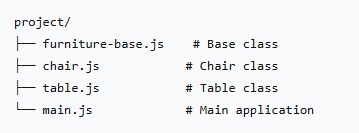
How It Works:
File 1: furniture-base.js (Export the base class)
export class Furniture {
 constructor(material) {
   this.material = material;
 }

 describe() {
   return `${this.material} furniture`;
 }
}
File 2: chair.js (Import and extend)
import { Furniture } from './furniture-base.js';
export class Chair extends Furniture {
 constructor(material, legs) {
   super(material);
   this.legs = legs;
 }

 sit() {
   return "Sitting comfortably";
 }
}
File 3: main.js (Use everything together)
import { Chair } from './chair.js';
import { Table } from './table.js';
const myChair = new Chair("wood", 4);
const myTable = new Table("glass", "round");
console.log(myChair.describe());  // "wood furniture"
console.log(myTable.describe());  // "glass furniture"
Challenge
You have an electronics store system organized into modules. The Laptop and Smartphone classes are created in separate files but need to be made available to other files.
Your task:
- Export the classes (use named exports - not default):
- In
laptop.js: Addexportto make theLaptopclass available - In
smartphone.js: Addexportto make theSmartphoneclass available
- In
- Import the classes in
main.js:- Import the
Laptopclass fromlaptop.js - Import the
Smartphoneclass fromsmartphone.js
- Import the
Try it yourself
// TODO: Import the Laptop class from laptop.js
// TODO: Import the Smartphone class from smartphone.js
const myLaptop = new Laptop();
const myPhone = new Smartphone();
console.log(myLaptop.type); // Outputs: "laptop"
console.log(myPhone.type); // Outputs: "smartphone" Test yourself
This lesson includes a short quiz. Start the lesson to answer it and track your progress.
All lessons in Object Oriented Programming
1Objects & The this Keyword
Quick Review: ObjectsAdding Methods to ObjectsUnderstanding the this KeywordConstructor FunctionsThe new KeywordRecap Challenge7 Inheritance & The extends Key
InheritanceThe "is-a" RelationshipThe extends KeywordThe super() MethodInheriting Properties&MethodsRecap Challenge2Organizing Code
What are Modules?Exporting with exportImporting with importDefault vs. Named Exports8Organizing OOP Code
Organize Classes into Modules11Project: A Shape Renderer
Setup: Shape Class & ExportCircle Class InheritanceOverriding & Area MethodStatic Shape Counter9Static Methods & Properties
Class-Level vs. Instance-LevelStatic PropertiesStatic Utility MethodsRecap challengePractice on your own: Online JavaScript compiler