“I’ll start that project on Monday.” “I’ll finish those lessons when work chills out.” “I’ll wait for the weekend to really dive in.”
We all know the feeling of waiting for the “perfect time” to start a new habit. And yes, building – and keeping – a habit can be hard, which is why we often wait for the next Monday or the 1st of next month to get serious. Or we just keep putting off the very things we know we should be doing.
When your to-do list is full of learning new frameworks and endless documentation, that wait becomes a trap. There is no such thing as the right time – we choose it, and the only time we really have is right now.
Waiting for “perfect timing” keeps us from starting. Best case scenario, we start – but it’ll likely be hard to keep going. The developers who build amazing things don't wait for the next Monday or the 1st of the month. They know that 15 minutes every day is worth more than a five-hour plan that never happens.
Coding is a skill that grows through practice, but only if you show up every day. Consistency is a habit that we build, just like the code itself. When we start now – no matter what day it is – we stop making excuses and start making progress.
To break the cycle of "starting tomorrow," we need to change how we look at our day. To do that, let’s look at seven daily habits that can help you become a better developer. Let’s dive in!
1. Commit to a Code Streak
There’s a psychological reason behind why streaks work. Daily streaks – which track how many days in a row you show up – help you build a habit. They turn a routine task into a game many don't want to lose.
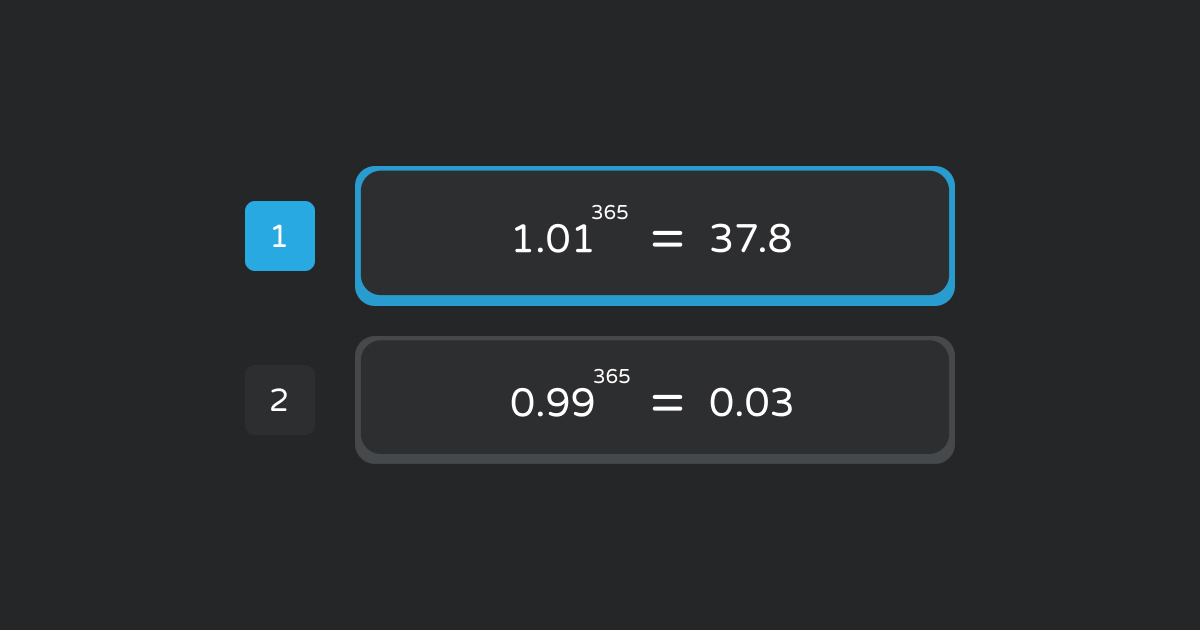
If you show up and give a tiny 1% extra every single day, you’ll end up almost 38 times better by the end of the year. But if you let things slide by even 1% every single day, you will practically drop to zero. So, are you building a superpower or dropping to nothing?
Loss aversion is the natural instinct to protect what we’ve already built. So, the mental 'cost' of breaking a 20-day streak becomes higher than the effort of a 5-minute quiz. Losing your momentum feels worse than the effort it takes to keep it. This keeps you showing up, even when your schedule is packed.
This also leaves a little task open in your mind (it’s called the Zeigarnik Effect). Your brain doesn't like leaving things unfinished, so it keeps thinking about the problem until it's done.
And, if life gets in the way, don't beat yourself up – you're not a robot! A great rule of thumb is to avoid skipping two days in a row. One day is a lucky break, but two days is the start of a new, unwanted habit of not coding.
2. Solve One Coding Challenge
If you look at a math problem that is already finished, you might think, "Oh, I get it." But if you had to solve that same problem on a blank piece of paper without help, you might get stuck. To really understand a solution, we need to do more than watch – we have to build it ourselves.
In engineering or physics, we don’t learn by memorizing the final result, but through the steps. Programming is no different. Even if we’re rebuilding a function we just watched in a video, typing out the code and hitting "run" is what turns the logic into something real that actually works.
Once you finish a lesson, try to rebuild that same logic in a blank file from memory. If you get stuck and have to peek at the solution, don't sweat it – it’s the actual work of going through the steps yourself that makes the knowledge stick.
The "aha" moments happen when the code breaks and you have to find your own way out. By proving the logic to yourself, you start to understand the why behind each move. Who knows – maybe you’ll find a better way to build it than the version you were originally following!
3. Test Your Knowledge with Quizzes
Don't wait for a high-stakes interview to realize you’ve forgotten how functions or logic loops work. Quizzes are like a playground where you can hunt for gaps in your understanding. Think of it as a safe space to practice your knowledge – a way to see what needs a bit more love without any of the stress.
This is all about active recall – a fancy way of saying you’re moving information into your long-term memory. By pulling the answer out of your head instead of just reading it off a page, you’re making that knowledge way easier to grab the next time you’re deep in a coding session.
Checking in on your progress every now and then is a great way to build up that "I've got this" energy. It’ll give you the confidence you need for when the pressure is on.
4. Check AI Explanations
Many developers use AI to understand the "how" behind a piece of code. When you use AI to help you, try not to just copy and paste the answer. Instead, take a moment to look at the explanation the AI provides. Ask it to walk you through the logic or the reasoning behind that specific solution.
Checking the AI’s logic is a great way to practice your own thinking. By looking closely at why a solution works, you train your brain to recognize those patterns. This habit helps you build the skills you need to solve similar problems on your own in the future.
If interested, read more on: Artificial Intelligence for Beginners: How to Talk to AI
5. Debug on the Go
Since you can code from anywhere (as long as you have a stable connection, of course), try using those little gaps in your day to knock out a lesson.
The best part about modern tools is that you aren't chained to a desk. We’ve all had those moments where a solution finally clicks while we're away from the screen. Use those in-between times – waiting for your coffee, sitting on the bus, or just hanging out – to complete one quick mobile lesson. It’s a great way to keep your momentum going without the pressure of a long study session.
Stepping away from your usual setup also helps your brain stay flexible. When you change your environment, you stop relying on "sitting at my desk" as the only trigger for thinking clearly. It trains you to think like a developer no matter where you are.
Making progress in these small bursts helps us stay consistent. It’s about making the habit fit into our life, rather than forcing our life to fit around the habit, which is the best way to avoid burnout.
6. Look Back at Your Certificates
Every week or two, we can take a moment to look back at what we’ve achieved. Updating your LinkedIn or resume with the skills you’ve mastered keeps your profile fresh and your momentum high.
Reviewing your earned certificates is a way to see your progress in black and white. It’s a win to realize how much you’ve truly learned, especially during times when the material feels hard.
This habit creates a positive feedback loop. When you see how far you’ve come and a record of your hard work, it makes you more likely to keep going. It’s a nice moment to step back from the daily grind and notice the new tools you’ve added to your kit.
Celebrating your wins, no matter how small, is a great way to stay motivated for the long run.
7. Compete and Collaborate
Coding can feel lonely, but it doesn't have to be! Platforms like Coddy make it easy to find other people who are learning the same things as you. Inside each of our interactive lessons and courses, you can see how you are doing compared to others.
Checking the leaderboards is a way to see how other learners are moving forward. This (friendly!) competition keeps your motivation high and reminds you that you aren’t alone. It is much easier to stay on track when you see a global community working toward the same goals. By following the leaderboards, you turn your daily practice into a shared experience.
Also, connecting with others doesn't just make you a better coder – it makes the whole journey a lot more fun!
Ready to Become a Better Developer?
To become a better developer, you don’t have to do a total lifestyle change – it’s really just about finding a routine that works for you.
Whether you’re looking to pick up a new language or just want to keep your skills from getting out of practice, the goal is to make progress in a way that fits into your life.
If you’re curious to see how these small daily wins feel, jump into one of Coddy‘s lessons and start building today!
Share this article
About the Author

Jana Simeonovska
Content Strategist & Writer
Frequently Asked Questions
What is a daily streak?
“Daily streak” is usually a way to keep users engaged by offering increasingly BETTER rewards the more the user stays active in a streak. The reasoning for this is that the user will keep logging in everyday because he wants the rewards to keep getting better and to get the big prize at the end.
How can I get better at coding?
Practice, practice, practice.
Putting your knowledge to use and challenging yourself can force you to grow in substantial ways that won't happen from reading books or attending lectures. If you want to code better, then you have to spend time coding.
Should I practice coding every day?
First off, daily practice leverages the power of habit and consistency. With each day of practice, you strengthen those new neural pathways associated with coding, enhancing your skill and efficiency. Sure, it's a pain to get started and form the habit, but it all adds up over time.
How to become good at development?
Solve real problems! You become a good developer not only for knowing the language. You become because you have the skills to solve problems. Problems could differ from compilation errors when dealing with business processes in your company.
Is it advisable to use AI for coding?
AI is a powerful tool for learning to code, but like any tool, it needs to be used wisely. Over-reliance can weaken critical thinking and problem-solving skills, while strategic use can accelerate learning.