





Periodic table of elements
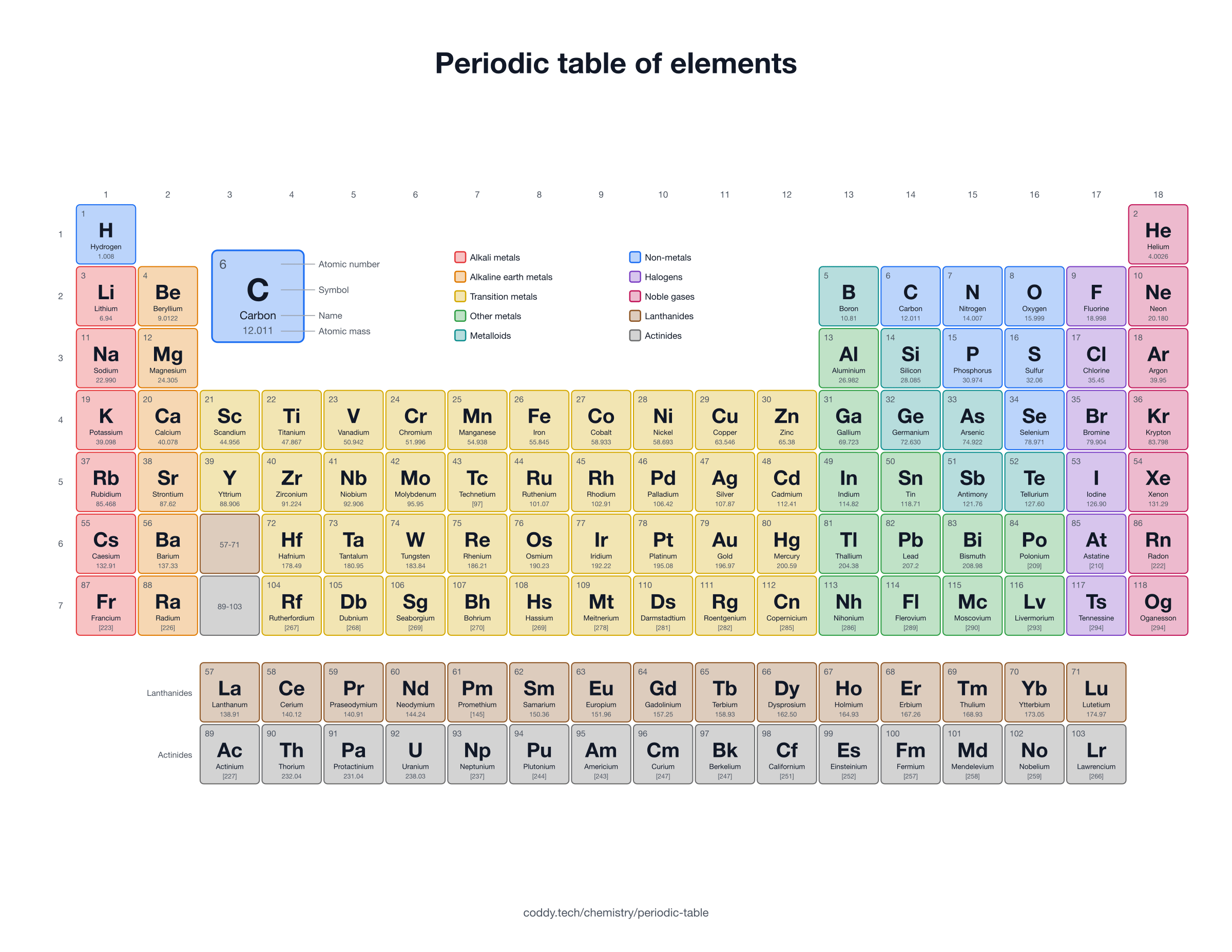
All 118 elements with their names, atomic numbers and atomic masses. Color the table by family, block, metal or non-metal, or by a trend such as electronegativity, and tap an element to see its electron configuration, valence electrons and more.
All 118 elements in a list
| No. | Symbol | Name | Atomic mass | Group | Period |
|---|---|---|---|---|---|
| 1 | H | Hydrogen | 1.008 | 1 | 1 |
| 2 | He | Helium | 4.0026 | 18 | 1 |
| 3 | Li | Lithium | 6.94 | 1 | 2 |
| 4 | Be | Beryllium | 9.0122 | 2 | 2 |
| 5 | B | Boron | 10.81 | 13 | 2 |
| 6 | C | Carbon | 12.011 | 14 | 2 |
| 7 | N | Nitrogen | 14.007 | 15 | 2 |
| 8 | O | Oxygen | 15.999 | 16 | 2 |
| 9 | F | Fluorine | 18.998 | 17 | 2 |
| 10 | Ne | Neon | 20.180 | 18 | 2 |
| 11 | Na | Sodium | 22.990 | 1 | 3 |
| 12 | Mg | Magnesium | 24.305 | 2 | 3 |
| 13 | Al | Aluminium | 26.982 | 13 | 3 |
| 14 | Si | Silicon | 28.085 | 14 | 3 |
| 15 | P | Phosphorus | 30.974 | 15 | 3 |
| 16 | S | Sulfur | 32.06 | 16 | 3 |
| 17 | Cl | Chlorine | 35.45 | 17 | 3 |
| 18 | Ar | Argon | 39.95 | 18 | 3 |
| 19 | K | Potassium | 39.098 | 1 | 4 |
| 20 | Ca | Calcium | 40.078 | 2 | 4 |
| 21 | Sc | Scandium | 44.956 | 3 | 4 |
| 22 | Ti | Titanium | 47.867 | 4 | 4 |
| 23 | V | Vanadium | 50.942 | 5 | 4 |
| 24 | Cr | Chromium | 51.996 | 6 | 4 |
| 25 | Mn | Manganese | 54.938 | 7 | 4 |
| 26 | Fe | Iron | 55.845 | 8 | 4 |
| 27 | Co | Cobalt | 58.933 | 9 | 4 |
| 28 | Ni | Nickel | 58.693 | 10 | 4 |
| 29 | Cu | Copper | 63.546 | 11 | 4 |
| 30 | Zn | Zinc | 65.38 | 12 | 4 |
| 31 | Ga | Gallium | 69.723 | 13 | 4 |
| 32 | Ge | Germanium | 72.630 | 14 | 4 |
| 33 | As | Arsenic | 74.922 | 15 | 4 |
| 34 | Se | Selenium | 78.971 | 16 | 4 |
| 35 | Br | Bromine | 79.904 | 17 | 4 |
| 36 | Kr | Krypton | 83.798 | 18 | 4 |
| 37 | Rb | Rubidium | 85.468 | 1 | 5 |
| 38 | Sr | Strontium | 87.62 | 2 | 5 |
| 39 | Y | Yttrium | 88.906 | 3 | 5 |
| 40 | Zr | Zirconium | 91.224 | 4 | 5 |
| 41 | Nb | Niobium | 92.906 | 5 | 5 |
| 42 | Mo | Molybdenum | 95.95 | 6 | 5 |
| 43 | Tc | Technetium | [97] | 7 | 5 |
| 44 | Ru | Ruthenium | 101.07 | 8 | 5 |
| 45 | Rh | Rhodium | 102.91 | 9 | 5 |
| 46 | Pd | Palladium | 106.42 | 10 | 5 |
| 47 | Ag | Silver | 107.87 | 11 | 5 |
| 48 | Cd | Cadmium | 112.41 | 12 | 5 |
| 49 | In | Indium | 114.82 | 13 | 5 |
| 50 | Sn | Tin | 118.71 | 14 | 5 |
| 51 | Sb | Antimony | 121.76 | 15 | 5 |
| 52 | Te | Tellurium | 127.60 | 16 | 5 |
| 53 | I | Iodine | 126.90 | 17 | 5 |
| 54 | Xe | Xenon | 131.29 | 18 | 5 |
| 55 | Cs | Caesium | 132.91 | 1 | 6 |
| 56 | Ba | Barium | 137.33 | 2 | 6 |
| 57 | La | Lanthanum | 138.91 | 6 | |
| 58 | Ce | Cerium | 140.12 | 6 | |
| 59 | Pr | Praseodymium | 140.91 | 6 | |
| 60 | Nd | Neodymium | 144.24 | 6 | |
| 61 | Pm | Promethium | [145] | 6 | |
| 62 | Sm | Samarium | 150.36 | 6 | |
| 63 | Eu | Europium | 151.96 | 6 | |
| 64 | Gd | Gadolinium | 157.25 | 6 | |
| 65 | Tb | Terbium | 158.93 | 6 | |
| 66 | Dy | Dysprosium | 162.50 | 6 | |
| 67 | Ho | Holmium | 164.93 | 6 | |
| 68 | Er | Erbium | 167.26 | 6 | |
| 69 | Tm | Thulium | 168.93 | 6 | |
| 70 | Yb | Ytterbium | 173.05 | 6 | |
| 71 | Lu | Lutetium | 174.97 | 6 | |
| 72 | Hf | Hafnium | 178.49 | 4 | 6 |
| 73 | Ta | Tantalum | 180.95 | 5 | 6 |
| 74 | W | Tungsten | 183.84 | 6 | 6 |
| 75 | Re | Rhenium | 186.21 | 7 | 6 |
| 76 | Os | Osmium | 190.23 | 8 | 6 |
| 77 | Ir | Iridium | 192.22 | 9 | 6 |
| 78 | Pt | Platinum | 195.08 | 10 | 6 |
| 79 | Au | Gold | 196.97 | 11 | 6 |
| 80 | Hg | Mercury | 200.59 | 12 | 6 |
| 81 | Tl | Thallium | 204.38 | 13 | 6 |
| 82 | Pb | Lead | 207.2 | 14 | 6 |
| 83 | Bi | Bismuth | 208.98 | 15 | 6 |
| 84 | Po | Polonium | [209] | 16 | 6 |
| 85 | At | Astatine | [210] | 17 | 6 |
| 86 | Rn | Radon | [222] | 18 | 6 |
| 87 | Fr | Francium | [223] | 1 | 7 |
| 88 | Ra | Radium | [226] | 2 | 7 |
| 89 | Ac | Actinium | [227] | 7 | |
| 90 | Th | Thorium | 232.04 | 7 | |
| 91 | Pa | Protactinium | 231.04 | 7 | |
| 92 | U | Uranium | 238.03 | 7 | |
| 93 | Np | Neptunium | [237] | 7 | |
| 94 | Pu | Plutonium | [244] | 7 | |
| 95 | Am | Americium | [243] | 7 | |
| 96 | Cm | Curium | [247] | 7 | |
| 97 | Bk | Berkelium | [247] | 7 | |
| 98 | Cf | Californium | [251] | 7 | |
| 99 | Es | Einsteinium | [252] | 7 | |
| 100 | Fm | Fermium | [257] | 7 | |
| 101 | Md | Mendelevium | [258] | 7 | |
| 102 | No | Nobelium | [259] | 7 | |
| 103 | Lr | Lawrencium | [266] | 7 | |
| 104 | Rf | Rutherfordium | [267] | 4 | 7 |
| 105 | Db | Dubnium | [268] | 5 | 7 |
| 106 | Sg | Seaborgium | [269] | 6 | 7 |
| 107 | Bh | Bohrium | [270] | 7 | 7 |
| 108 | Hs | Hassium | [269] | 8 | 7 |
| 109 | Mt | Meitnerium | [278] | 9 | 7 |
| 110 | Ds | Darmstadtium | [281] | 10 | 7 |
| 111 | Rg | Roentgenium | [282] | 11 | 7 |
| 112 | Cn | Copernicium | [285] | 12 | 7 |
| 113 | Nh | Nihonium | [286] | 13 | 7 |
| 114 | Fl | Flerovium | [289] | 14 | 7 |
| 115 | Mc | Moscovium | [290] | 15 | 7 |
| 116 | Lv | Livermorium | [293] | 16 | 7 |
| 117 | Ts | Tennessine | [294] | 17 | 7 |
| 118 | Og | Oganesson | [294] | 18 | 7 |
Printable periodic table
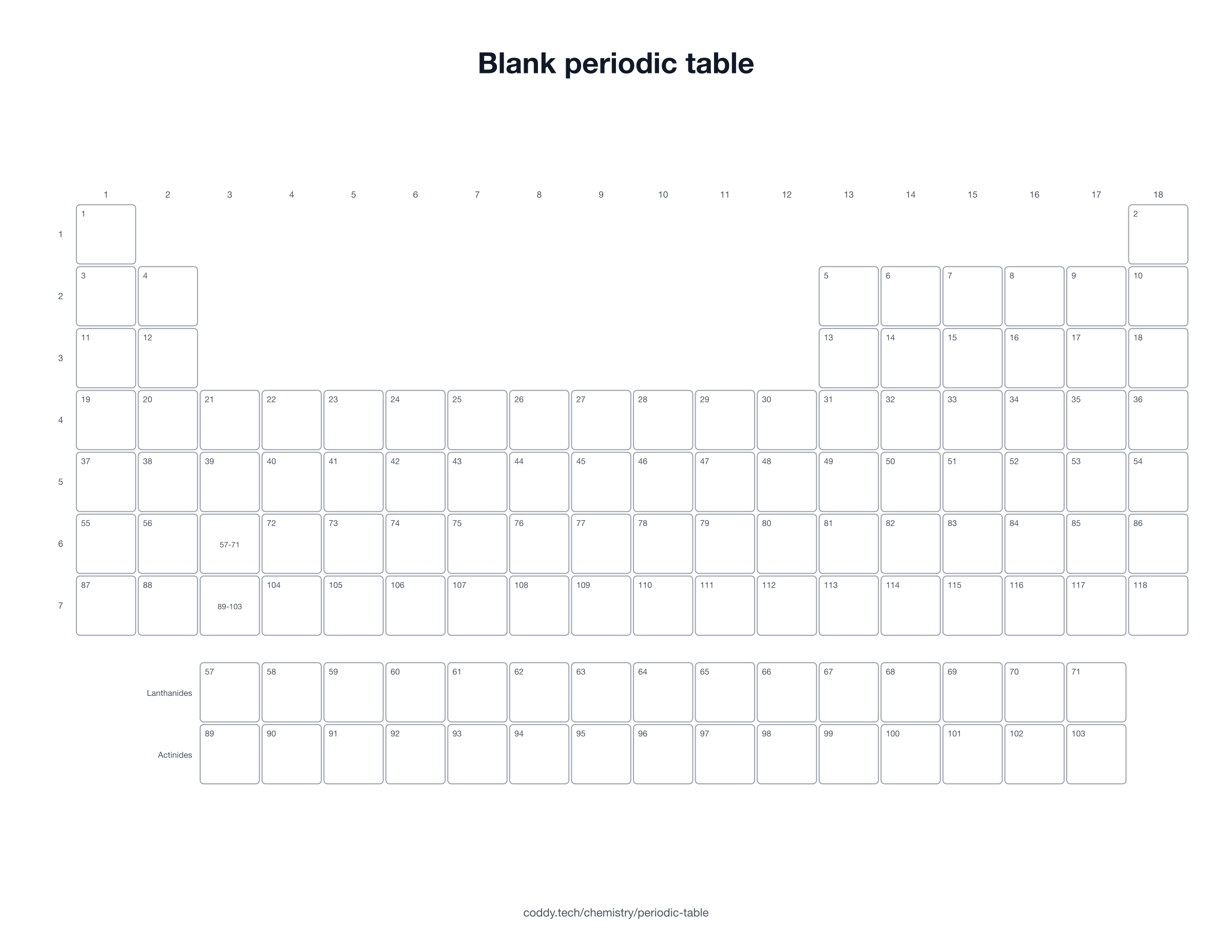
Download the periodic table as a PDF to print or as a PNG image, in color or blank to fill in. Or customize it: choose the coloring, what each cell shows, the paper size and a title, then print it or save it.
How to read the periodic table
The elements are in order of atomic number, the number of protons in the nucleus, from hydrogen (1) to oganesson (118). Each row is a period and each column is a group. The period number tells you how many electron shells an atom uses. In the main groups, elements in the same column have the same number of outer electrons, which is why they react in the same way: sodium and potassium both lose one electron, chlorine and bromine both gain one.
Groups and families
Group 1 holds the alkali metals, soft metals that react with water. Group 2 holds the alkaline earth metals, group 17 the halogens and group 18 the noble gases, which almost never react. Groups 3 to 12 are the transition metals, such as iron, copper and gold. The lanthanides and actinides are the two rows under the table: they belong in periods 6 and 7, and are written apart so the table stays 18 columns wide.
The s, p, d and f blocks
The block of an element is the subshell its last electron goes into. Groups 1 and 2 (and helium) form the s-block, groups 13 to 18 the p-block, the transition metals the d-block and the lanthanides and actinides the f-block. The shape of the table comes from the order the subshells fill: 1s, 2s, 2p, 3s, 3p, 4s, 3d and so on. Tap any element to see its full electron configuration.
Metals, non-metals and metalloids
Most elements are metals: everything on the left and in the middle of the table. The non-metals sit at the top right, and hydrogen, placed over group 1 because it has one outer electron, is a non-metal too. Between them, along the staircase line, are the metalloids, such as boron, silicon, germanium and arsenic, which behave partly like both.
Periodic trends
Across a period each element has one more proton pulling on the same outer shell, so atoms get smaller and hold their electrons more tightly: ionization energy and electronegativity rise. Down a group each element adds a shell, so atoms get larger and the outer electrons are easier to remove. Pick a trend above to see it colored across the whole table.
Learn the periodic table by building it
The Atomic Structure section of Coddy's chemistry course teaches the table from the atom up: you build atoms and ions, fill shells and orbitals, then place, sort and color elements on a table that checks every answer. Free, in your browser.
Frequently asked questions
How many elements are on the periodic table?
118, from hydrogen (atomic number 1) to oganesson (118). The last four, nihonium, moscovium, tennessine and oganesson, were named in 2016. The elements past uranium (92) are made in reactors and laboratories; only traces of a few of them occur in nature.
Who made the periodic table?
Dmitri Mendeleev published it in 1869. He ordered the elements by atomic mass, put elements that behave alike in the same column and left gaps for elements nobody had found yet, predicting their properties. Gallium, scandium and germanium were found soon after and fit his gaps. In 1913 Henry Moseley showed that the true order is the atomic number.
How do you find valence electrons on the periodic table?
For the main groups, read them from the group number: group 1 has 1 valence electron, group 2 has 2, and groups 13 to 18 have the group number minus 10, so oxygen in group 16 has 6. Helium has 2. Tap an element above and its card shows its valence electrons.
Why are the lanthanides and actinides under the table?
They are the f-block, and they belong in periods 6 and 7 between groups 2 and 3. Written in place, the table would be 32 columns wide, so most tables print those two rows underneath. The cells marked 57-71 and 89-103 show where they fit.
Can I download a printable periodic table?
Yes, for free. The PDF and PNG above show all 118 elements with names, atomic numbers and atomic masses, colored by family, and there is a blank table to fill in. With Customize you can color the table by block, metal type or a trend, print it in black and white, choose A4 or Letter and add a title or your name.
Is hydrogen a metal?
No. Hydrogen is a non-metal, a gas made of H₂ molecules. It sits above group 1 because, like the alkali metals, its atom has a single outer electron, which it can lose to form H⁺.
