Sine, cosine and tangent
- sin θ = a / c
- cos θ = b / c
- tan θ = a / b
a opposite sideb adjacent sidec hypotenuse
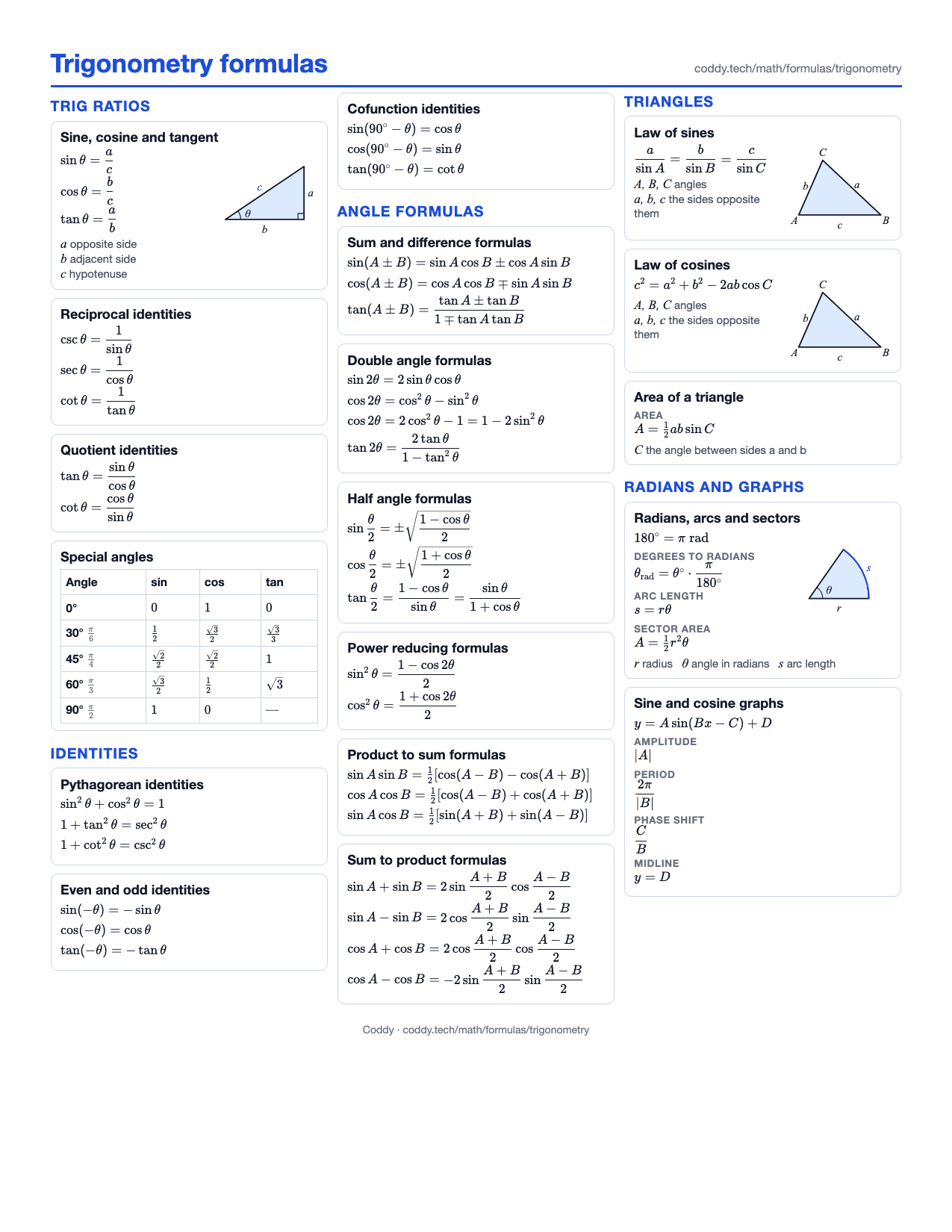
Every trigonometry formula on one sheet: the three ratios, the identities that follow from them, the angle formulas, the laws of sines and cosines, radians and graphs.
Last updated
Every trigonometry formula on one page: the three ratios, the identities, the angle formulas, the laws for any triangle, radians and graphs. Each symbol is named under its formula. Switch to quiz mode to hide the formulas and test yourself, or print the whole sheet.
a opposite sideb adjacent sidec hypotenuse
A, B, C anglesa, b, c the sides opposite them
A, B, C anglesa, b, c the sides opposite them
C the angle between sides a and b
r radiusθ angle in radianss arc length
In a right triangle, pick one of the two acute angles and call it θ. The side across from it is the opposite side, the side next to it is the adjacent side, and the longest side is the hypotenuse. Then:
Almost every other line on the sheet is one of these three, rearranged.
Put the triangle inside a circle of radius 1. The hypotenuse is 1, so the two legs are exactly cos θ and sin θ, and the Pythagorean theorem gives sin²θ + cos²θ = 1.
That one line gives the other two. Divide every term by cos²θ and you get tan²θ + 1 = sec²θ; divide by sin²θ instead and you get 1 + cot²θ = csc²θ. The unit circle page shows the triangle moving round the circle.
Learn the sum formulas for sine and cosine. Everything in the angle formulas section follows from them:
The ratios need a right angle. For any other triangle, label each angle with a capital letter and the side across from it with the same small letter. Then:
A full turn is 360°, or 2π radians, so 180° = π radians. The identities hold in either unit. The arc length s = rθ and the sector area A = ½r²θ need θ in radians: that is what makes them so short.
For where these values come from, read SOHCAHTOA and the unit circle. The geometry formula sheet has the area, volume and coordinate formulas.
Yes. Everything on this page is also a free letter-size PDF and a PNG. The download buttons are above the sheet and again under it.
sin²θ + cos²θ = 1, 1 + tan²θ = sec²θ and 1 + cot²θ = csc²θ. Only the first is worth memorizing: divide it by cos²θ to get the second and by sin²θ to get the third.
Use the law of sines when you know an angle and the side opposite it, plus one more side or angle. Use the law of cosines when you know two sides and the angle between them, or all three sides. In a right triangle you need neither: the ratios sin, cos and tan are enough.
The three ratios, sin²θ + cos²θ = 1 and the sum formulas for sin and cos. The double angle formulas are the sum formulas with B = A, the half angle and power reducing formulas come from the double angle ones, and the reciprocal and quotient identities are definitions.
Yes, every identity holds in either unit. Only the formulas that mix an angle with a length need radians: the arc length s = rθ and the sector area A = ½r²θ are true only when θ is in radians.