Square
- Area
- A = s²
- Perimeter
- P = 4s
s side
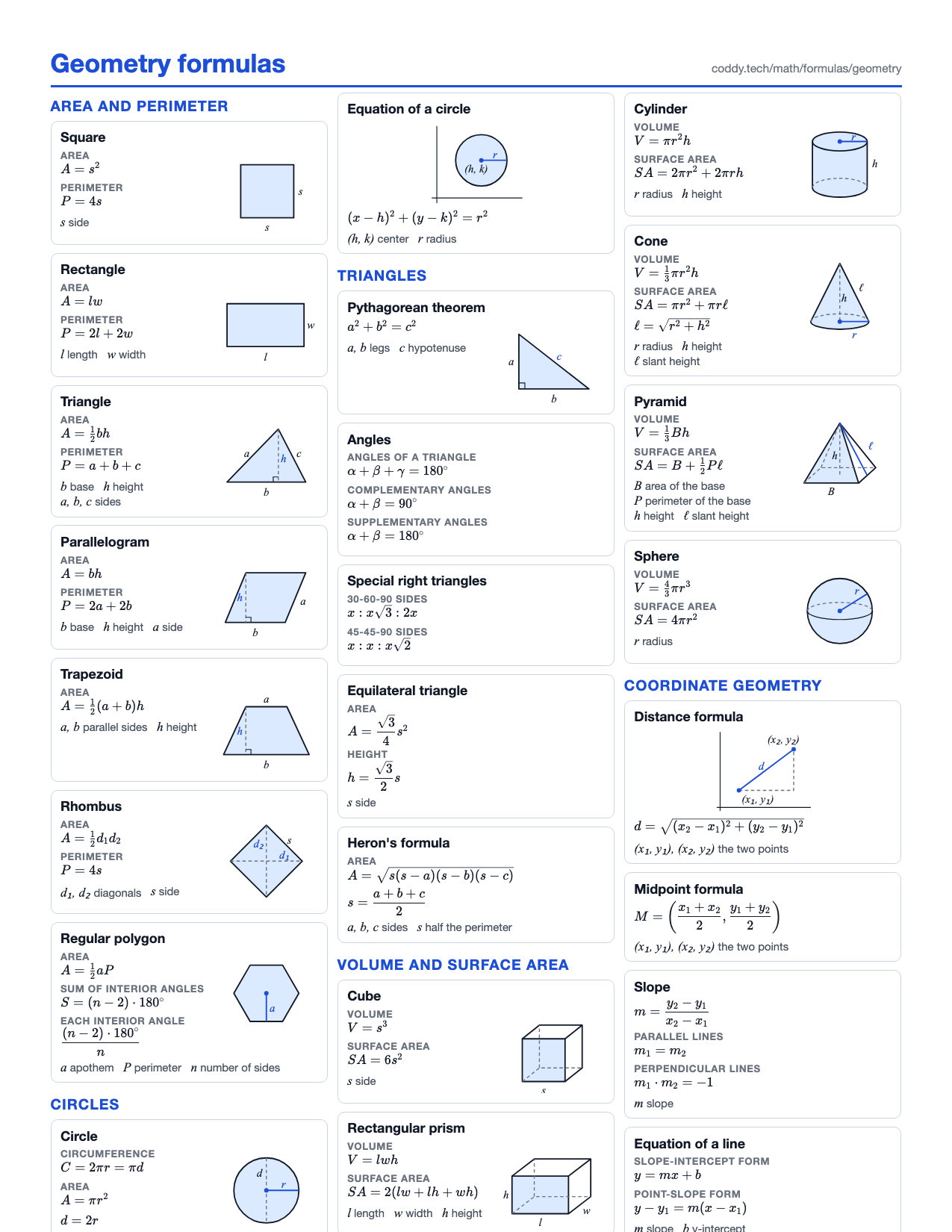
Every formula a geometry course uses, on one sheet: area and perimeter, circles, triangles, volume and surface area, and coordinates, each with a figure and every symbol named.
Last updated
Every formula a geometry course uses, on one page. Each shape has its figure, so you can see which length is the base and which is the height, and every symbol is named under the formula. Switch to quiz mode to hide the formulas and test yourself, or print the whole sheet.
s side
l lengthw width
b baseh heighta, b, c sides
b baseh heighta side
a, b parallel sidesh height
d₁, d₂ diagonalss side
a apothemP perimetern number of sides
r radiusd diameter
θ central angler radius
(h, k) centerr radius
a, b legsc hypotenuse
s side
a, b, c sidess half the perimeter
s side
l lengthw widthh height
B area of the baseP perimeter of the baseh height
r radiush height
r radiush heightℓ slant height
B area of the baseP perimeter of the baseh heightℓ slant height
r radius
(x₁, y₁), (x₂, y₂) the two points
(x₁, y₁), (x₂, y₂) the two points
m slope
m slopeb y-intercept
Find the shape, then match each letter in the formula to the figure. The letters are the usual ones in textbooks: b for a base, h for a height, r for a radius. A height is always measured at a right angle to the base, which is why the figures draw it dashed with a small square: on a slanted shape like a parallelogram, the height is not the slanted side.
Capital B means the area of a base, not a length. In V = Bh you first find the area of the end face (a triangle, a circle, any shape) and then multiply by the height.
Take a rectangle 3 cm by 4 cm. Its perimeter is the distance around it: 3 + 4 + 3 + 4 = 14 cm. Its area is how many 1 cm squares fit inside: 3 · 4 = 12 cm². Stand it up as a box 5 cm tall and the volume is how many 1 cm cubes fit inside: 3 · 4 · 5 = 60 cm³.
The units tell you which formula you need. A length times a length is an area; a length times a length times a length is a volume. If an answer about a volume comes out in square units, a factor is missing.
Most of the sheet is a handful of ideas applied to different shapes.
A can is 10 cm tall with a radius of 3 cm. How much does it hold?
It is a cylinder, so V = πr²h. The base is a circle of area π · 3² = 9π, and the height is 10, so the volume is 90π, about 283 cm³. That is 283 ml: a little less than a standard soda can.
The formulas tell you what to compute, and the Pythagorean theorem calculator and the volume calculator will do the arithmetic and show each step. For the angles and ratios inside triangles, the trigonometry formula sheet is the next page.
Yes. The sheet on this page is also a free letter-size PDF and a PNG, with the same figures and formulas. The download buttons are above the sheet and again under it.
Area measures a flat shape: how much paper a rectangle covers. Surface area measures the outside of a solid: how much paper it takes to wrap a box. A box's surface area is the sum of the areas of its six faces, which is where SA = 2(lw + lh + wh) comes from.
A cone fits inside a cylinder with the same base and height, and it holds exactly a third of it: fill the cone with water three times and you fill the cylinder. The same third turns up for a pyramid inside a prism, so V = (1/3)Bh covers both.
Fewer than the sheet suggests. Learn the rectangle, the triangle (half a rectangle), the circle, V = Bh for anything with straight sides and the same cross section, and the one third for anything that comes to a point. Most of the rest are those with a particular base put in.
Lengths and perimeters are in plain units (cm), areas in square units (cm²) and volumes in cubic units (cm³). Checking the units is the fastest way to catch a wrong formula: if a volume came out in cm², a length was left out.
Want to run this on your own numbers?
Volume Calculator Open the calculator