Current and charge
- Current
- I = ΔQ / Δt
- Charge
- Q = ne
I currentQ chargen number of chargese elementary charge
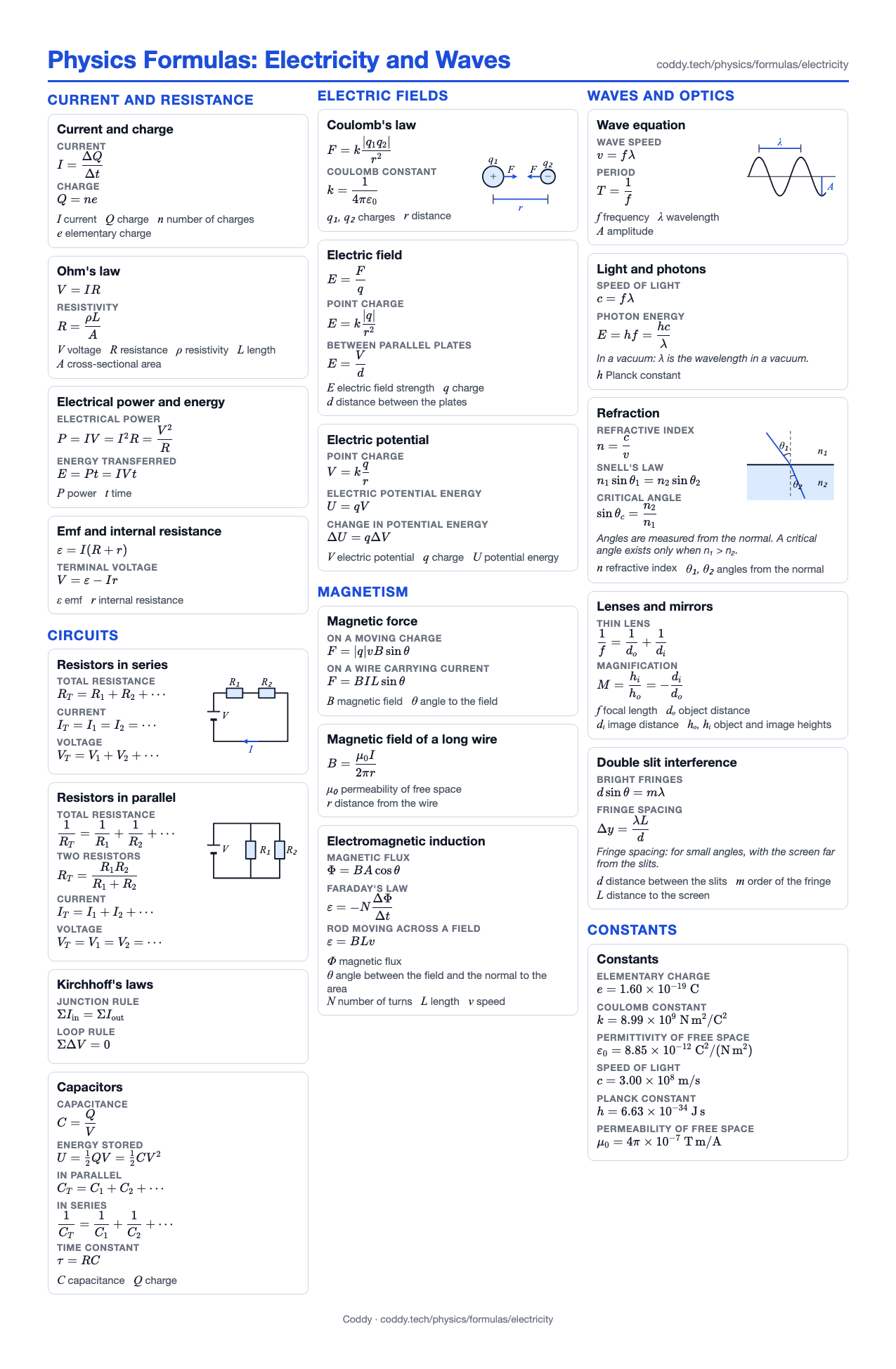
The key formulas for circuits, fields and waves on one physics sheet: current and resistance, series and parallel circuits, capacitors, electric fields, magnetism, waves, light and lenses, with the symbols named.
Last updated
The key formulas for circuits, fields and waves on one page: the electricity, magnetism and waves of AP Physics 2 and of A level physics. Symbols and conditions are named under each formula, and the sheet ends with the constants. Formulas with a calculator link to it, so you can try your own values. Switch to quiz mode to hide the formulas and test yourself, or print the whole sheet.
I currentQ chargen number of chargese elementary charge
V voltageR resistanceρ resistivityL lengthA cross-sectional area
P powert time
ε emfr internal resistance
C capacitanceQ charge
q₁, q₂ chargesr distance
E electric field strengthq charged distance between the plates
V electric potentialq chargeU potential energy
B magnetic fieldθ angle to the field
μ₀ permeability of free spacer distance from the wire
Φ magnetic fluxθ angle between the field and the normal to the areaN number of turnsL lengthv speed
f frequencyλ wavelengthA amplitude
In a vacuum: λ is the wavelength in a vacuum.
h Planck constant
Angles are measured from the normal. A critical angle exists only when n₁ > n₂.
n refractive indexθ₁, θ₂ angles from the normal
f focal lengthdₒ object distancedᵢ image distancehₒ, hᵢ object and image heights
Fringe spacing: for small angles, with the screen far from the slits.
d distance between the slitsm order of the fringeL distance to the screen
Most circuit questions come down to two rules. In series, one after the other, every component carries the same current and the voltages add up to the battery's. In parallel, side by side, every branch has the same voltage and the currents add up to the total.
That is why resistance adds in series and gets smaller in parallel. Two 6 Ω resistors in series make 12 Ω; the same two in parallel make 3 Ω, because the current now has two paths instead of one. Many circuits that mix the two can be solved from the inside out: replace each parallel group with its single resistance, then add the series ones. A circuit that cannot be split that way, such as a bridge, needs Kirchhoff's laws.
P = IV, P = I²R and P = V² / R are one formula, with V = IR put in to remove the quantity you do not know. Use the one that needs only what you have. A 60 W lamp on a 230 V supply draws I = 60 / 230, about 0.26 A, and its resistance is R = 230² / 60, about 880 Ω. The Ohm's law calculator solves all four for whatever you leave blank.
The energy a device uses is its power times the time it runs, E = Pt. In joules the time is in seconds; on an electricity bill the power is in kilowatts and the time in hours, which gives kilowatt hours.
AP Physics 2 writes ΔV for a voltage, where this sheet and A level write V, and it writes Coulomb's law with 1 / (4πε₀) in place of k: the sheet gives both, since they are the same number. A level writes the thin lens equation as 1 / f = 1 / u + 1 / v, with u and v the object and image distances; this sheet keeps d_o and d_i so that v can stay a speed.
The wavelength calculator works the wave equation and the photon energy for any value you leave blank, and the other physics calculators show each step. For motion, forces and energy, the mechanics formula sheet is the other half of the course.
V = IR: the voltage across a resistor is the current through it times its resistance. A 6 V battery across a 3 Ω resistor drives a current of 2 A. It holds for resistors at a constant temperature; a filament lamp or a diode does not follow it.
Add the reciprocals: 1/R_T = 1/R₁ + 1/R₂. For two resistors that is R_T = R₁R₂ / (R₁ + R₂), so 6 Ω and 3 Ω in parallel make 2 Ω. The total is always smaller than the smallest resistor, because each branch adds another path for the current.
The emf ε is the energy a battery gives each coulomb of charge. When the battery delivers a current, the voltage at its terminals is less than that, because some of the energy is used up inside the battery: V = ε − Ir, where r is its internal resistance.
The speed of a wave is its frequency times its wavelength, v = fλ. For light in a vacuum the speed is c, so green light with a wavelength of 500 nm has a frequency of 3.00 × 10⁸ / 5.00 × 10⁻⁷ = 6.0 × 10¹⁴ Hz. A higher frequency always means a shorter wavelength at the same speed.
It covers the main formulas of the electricity, magnetism, waves and optics in AP Physics 2, not its thermodynamics or modern physics. In the exam the College Board gives you its own equation sheet, so practise with that one and use this as a free supplement.
Want to run this on your own numbers?
Ohm's Law Calculator Open the calculator