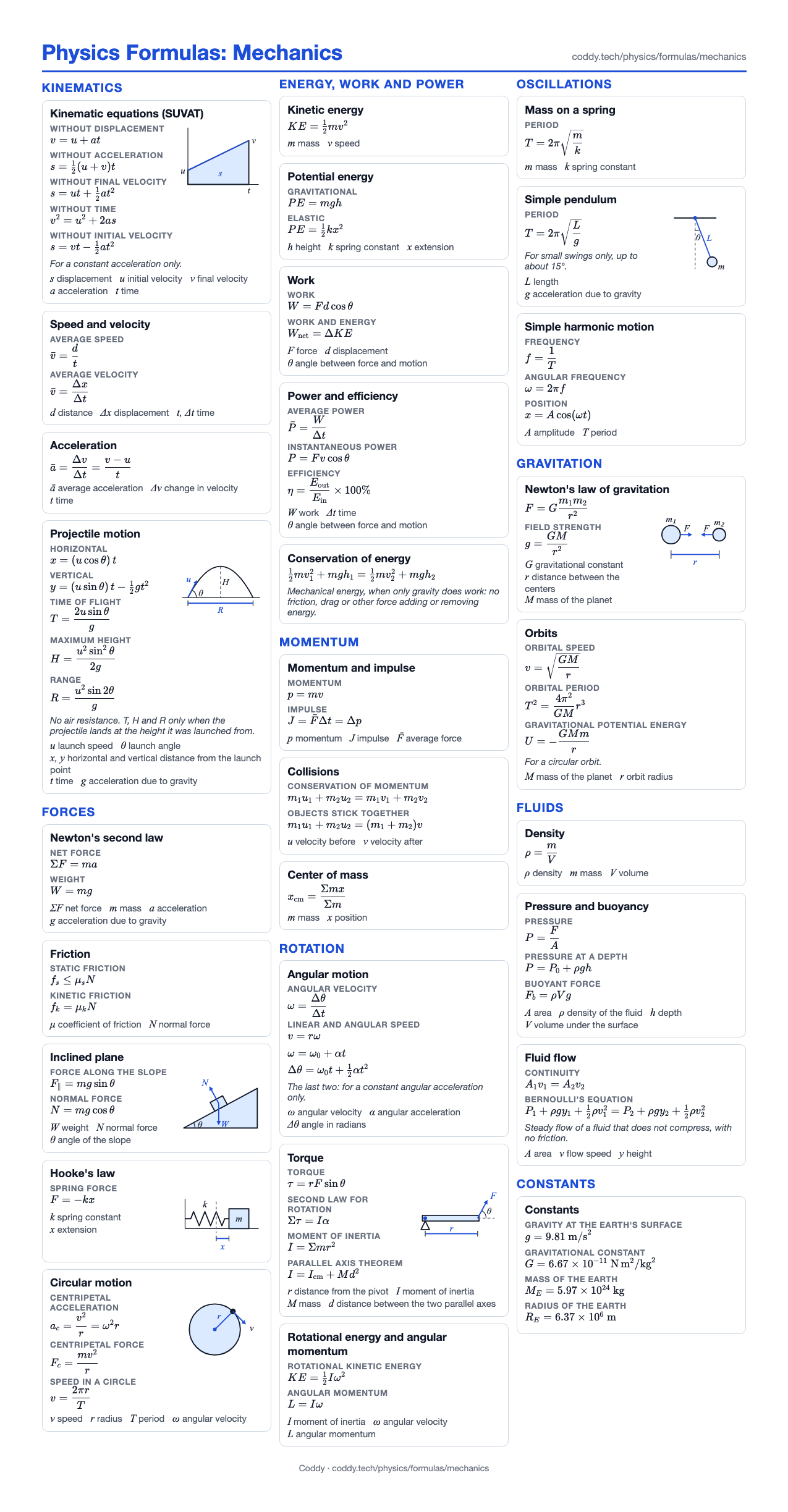
The key formulas of a mechanics course on one page, grouped by the topics of
AP Physics 1 and of A level mechanics. Symbols and conditions are named under
each formula, and the sheet ends with the constants. Formulas with a
calculator link to it, so you can try your own values. Switch to quiz mode to
hide the formulas and test yourself, or print the whole sheet.
How to pick a kinematic equation
The five kinematic equations link five quantities: the displacement
s, the initial velocity u, the final velocity
v, the acceleration a and the time t.
That is why UK courses call them the SUVAT equations. Each equation leaves out
exactly one of the five.
So write down the three values you know and the one you want. The letter left
over is the one you neither have nor need, and the equation without it is the
one to use. A car braking from 20 m/s to a stop in 50 m, with no time given
and none asked for, calls for
v² = u² + 2as, the equation without
t: 0 = 20² + 2a · 50, so
the car slows at 4 m/s².
The equations hold only while the acceleration is constant. A falling stone
qualifies (until air resistance matters); a car that speeds up and then brakes
has to be split into two parts, each with its own acceleration.
Signs and directions
Displacement, velocity, acceleration, force and momentum all have a direction,
and the sheet writes them as plain numbers. Pick one direction as positive at
the start of a problem and keep it. If up is positive, a ball thrown upward has
a positive u and an acceleration of
−9.81 m/s², and its displacement turns negative once it
falls below the point it was thrown from.
The minus sign in Hooke's law, F = −kx, says the same
thing: the spring pushes back against the way it was stretched. When you only
want the size of the force, use kx.
Physics courses agree on the formulas and disagree on the letters. This sheet
uses the letters of the kinematics calculator
and of most UK courses. AP Physics 1 writes the same ideas this way:
- Kinematics: v₀ for the initial velocity
u, and Δx for the displacement
s, so v² = u² + 2as becomes
v² = v₀² + 2aΔx.
- Energy: K for kinetic energy and U_g
for gravitational potential energy, where this sheet writes KE and PE. A
level writes E_k and E_p.
- Weight: F_g for the weight W, which
leaves W free for work.
Units
Every formula on the sheet works in SI units: metres, kilograms and seconds.
The others are built from those three. A newton is the force that gives 1 kg
an acceleration of 1 m/s², a joule is the work of 1 N over 1 m, and a watt is
1 J every second. Convert kilometres per hour, grams and minutes before you
substitute, and the answer comes out in the right unit with no further work.
Where to go next
The physics calculators solve these formulas for any
value you leave blank and show each step, from the
force calculator to the
momentum calculator. For circuits,
fields and waves, the electricity formula sheet
is the next page.